Interview
The Closest to the People
Crystal Hudson never planned to run for office. She was elected to the New York City Council in 2021 representing Crown Heights, Prospect Heights, Clinton Hill, and Fort Greene, and she has passed more legislation in her second term than any other member. But when she sat down with the Local Leader Lab, she spent most of the hour on the parts nobody puts in the recruitment pitch.
What follows is lightly edited for length.
You worked in government before you ran. What made you decide to be the one on the ballot?
“When I first left the private sector, really the goal for me was to just work in government, because I felt like nobody in government must understand firsthand how difficult it is for those of us outside of government trying to navigate bureaucracy. I thought very naively, if only I work in government, then certainly I can change all of these awful systems. It was never a goal to run for office.”
She was a staffer for her predecessor. When that seat opened up, people started asking.
“For a long time I was like, oh, absolutely not. I didn’t come here for that. I thought I could be best served in the background, actually changing the systems and making things function better.” 
What did the decision actually cost?
“My mother actually died during my campaign, and so she was alive when I made the decision to run. Caring for her was a huge burden on us. It was thinking, can I continue to take care of my mother in the way that she deserves to be taken care of, and then also run for office in the way that deserves and needs to be treated like a full time job.”
She quit her job and campaigned full time. Then came the part almost nobody mentions.
“The primary election is usually months before the general election, and then months before you’re sworn into office and you start getting a paycheck. I was not working for a full year until I came into office.”
Why does this feel harder for some people than others?
Her answer was not about confidence.
“You have to pay bills. You have to pay your mortgage, pay your rent, pay for childcare, pay for medicine, groceries, whatever it is. Historically you have men who have had women at home doing everything, and they haven’t had to think about that. The structures that exist have allowed for a very particular demographic to make it look easy, to make it look like all you have to do is just jump in and do the thing. But the reality for so many more of us today is that there is nobody at home to do it.”
What surprised you most about campaigning?
“Nobody warns you about the complete loss of privacy.”
In New York, a voter’s address is public record. She recommends finding out what is public where you live and protecting whatever you still can.
“I have a young daughter, and we’ve never posted her photo online. That’s just a personal family decision we’ve made. You should be thinking about what is available to everybody online. What parts of you, what type of personal information. It takes one photo. Somebody can take one photo or one video and manipulate that into a million different ways.” 
How do you decide where to spend your time?
“I’m just very clear on why I’m here. To make government more accessible to more people, to make it work better for more people, and to do as much as I can to make New York City the best place for everyone to grow older. That’s sort of like my North Star.”
For her, that means constituent services come first, ahead of legislation.
“When I go into schools and speak to kids, I say, you’ve probably never met the president. You’ve probably never met the mayor or a US senator. But I’m here as your council member in your classroom. That means I am the most accessible form of government. I’m the closest to the people.”
What does that look like on an ordinary day?
“I’ll use a Wednesday, because on Wednesdays we have housing help in my office. We have housing specialists and attorneys and tenant organizers who come in, and a full waiting room of people who speak all different languages, who come from all over the city.”
The office then asks itself a second question: what did we see today that we could fix upstream? One current bill would automatically enroll people in public benefits they already qualify for.
“If we know at 65 you become eligible for a number of programs based on your age, we should be automatically enrolling you, as opposed to waiting for you to learn about them and then come to our office. The onus should always be on government, not on the individual.”
What should women do now, before they run?
“Go through everybody in your phone. Write out how much you think you can ask them to give in terms of campaign donations. And then call them. You never realize how many people you have saved in your phone until you have to do this exercise.”
She was one of the top fundraisers in her 2021 race, and she credits the reframe as much as the personality.
“You have to really think of it as an investment in your community. It’s not like you’re taking that money and putting it in your pocket. It’s money they are investing to ensure that your community has the best representation it could have.”
She still remembers the first donation from someone she had never met.
“There was one name and I was like, I don’t know this person. And then I looked them up and I was like, oh, I really don’t. A stranger donated to me. That is a really cool feeling. And then it snowballs.” 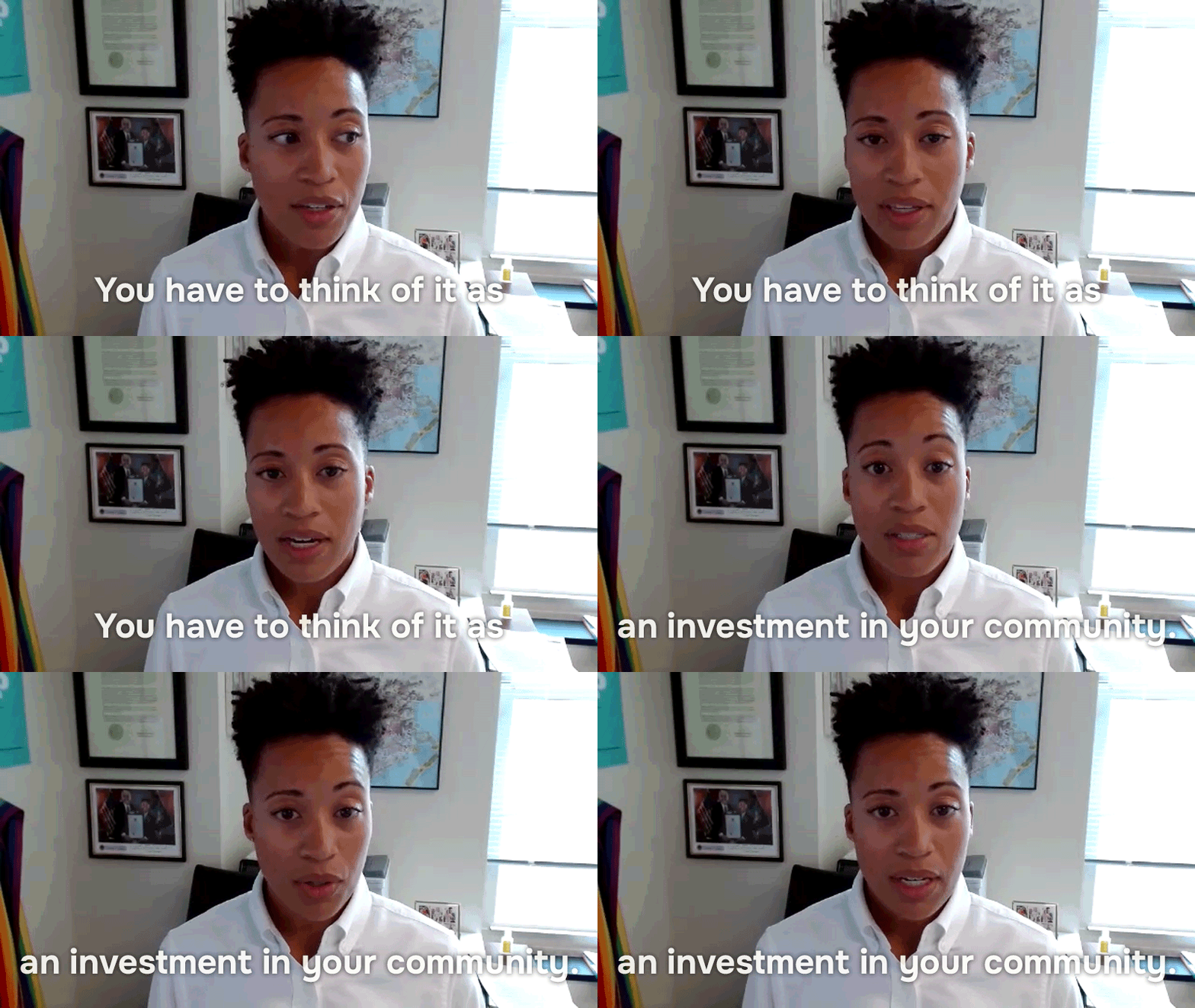
What if you’re being outraised ten to one?
One Lab member asked this directly. She had raised $500. Her opponent had raised $50,000.
“I don’t think it’s an assessment on credibility. Your opponent may be spending $50,000 on frivolous things, and you might be spending that $500 on things that actually matter and that are reaching voters. Your money should always be going to reaching voters. I would think about where you got that $500 from. Can you go back to those people for another $500, and can they tell the people they know? How can you multiply that $500?”
Asked whether a campaign can run on nothing, she was blunt. No. But she does not think money is the deciding factor.
“The biggest bang for your buck is in volunteers. I’ve had people outspend me dollar to dollar because I’ve had the most volunteers. They’re paying people to do the work that I have volunteers doing.”
What do you want women to take with you?
“When you think about the people with the greatest needs, then everybody else benefits. When you prioritize and center the people who’ve been disinvested in, the people who’ve experienced redlining, the people who have not had investments in their communities or in their schools, then everybody benefits.”