The Local Leader Lab Just Wrapped Its Second Cohort. Here’s What We Learned.
It was “I’m not the expert. Someone else knows more than I do. Who am I to lead on this?”
We heard it in Week 1 and kept hearing it all the way through Week 7. Women who were already doing the work, already showing up at city council meetings, already organizing neighbors, already deep in issues they cared about, still convinced that something was missing. That they needed more credentials, more certainty, more proof that they had the right to take up space.
By our final session, those same women were naming their next move. Not someday. The meeting they had scheduled for next week. The library listening session already on the calendar. The elected official who had already responded. One woman launched a public event the same night the program ended.
They had a different relationship to what they already had.
What the Lab Is Actually For
The Local Leader Lab invests in the leader, not the next role. Some women in this cohort are actively positioning themselves for a run for public office. Some are pursuing board seats or appointed positions. Some are building something in their community that does not have a title yet. Where she goes from here is hers to decide. The Lab just makes sure she is ready when she gets there.
Who shows up to that is interesting. In Cohort 2, the women who raised their hands included a three-term town council member, a 21-year federal civil servant, a Congressional fellow, and dozens of women already serving on school boards, zoning boards, and county commissions. That is not who we require. It is who self-selected in this moment, in this political environment, when women with years of public service experience looked around and decided they were ready to go further.
Over ten weeks, participants map opportunities to step up their leadership, connect with each other and with 1:1 coaches, and design and launch meaningful civic activations in their own communities.
What Cohort 2 reminded me is that this design works even when the world outside is loud and hard. Maybe especially then.
The Thing That Was Surprising
We expected Cohort 2 to look a lot like Cohort 1. We had refined the curriculum. We had trained our facilitators. We had the playbook.
What we did not expect was how much the cohort would become its own infrastructure.
Partway through the program, groups started forming their own group chats without being asked. Participants were reaching out to each other between sessions, sharing resources, co-working on ideas, making plans to meet in person. One participant sat down at the final session and posted in the chat: “I’m gonna miss my days with everyone. This has been something I looked forward to every other week and every week. Now it’s gonna feel like there’s a little void there.”
We built the program. They built the community. Not exactly what was planned, but it is something we are building toward now.
What They Built
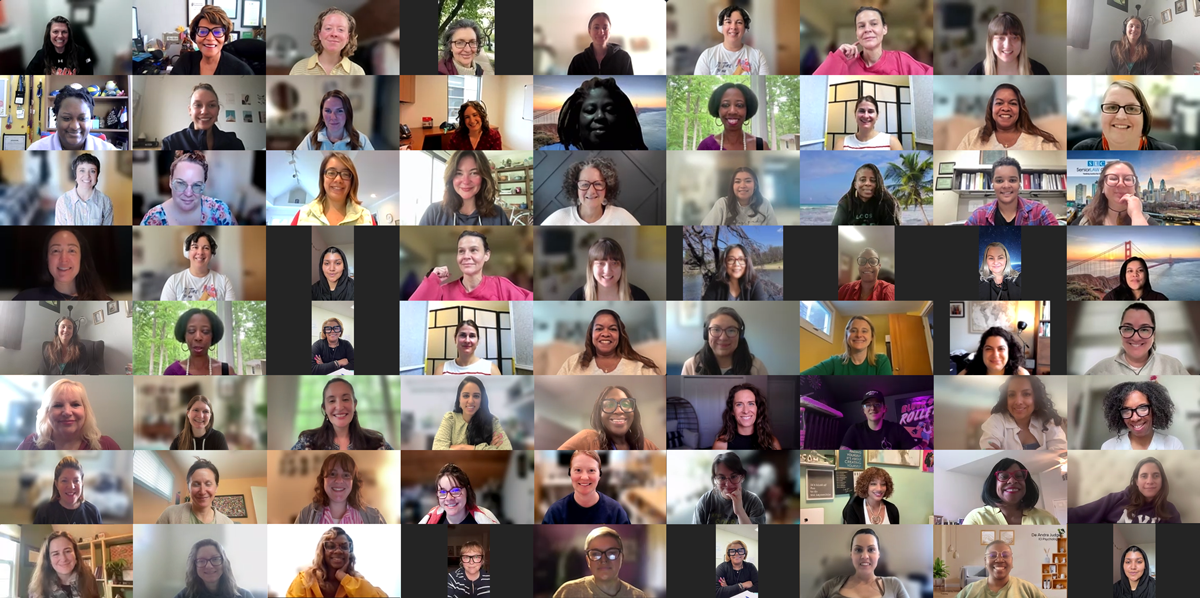
These projects span reproductive justice, gun violence prevention, special education advocacy, local government transparency, voter registration, environmental health, community skating events, small business ethics, AI ethics for elected officials, neighborhood listening sessions, and more. Here is a small window into what this cohort created:
Morgan met one on one with her city councilor about lighting at a community park she’d been watching go dark. He told her about a special fund that could cover it. She is following up.
Carrie raised her hand to lead voter registration efforts across her 400-person sorority chapter and linked up with the League of Women Voters to do it right.
Abby has been sitting on an idea for a community fridge in her neighborhood for years. The Lab gave her the structure, accountability, and push to take the next step.
Jenn built onegoodconversation.org. She told us not to click the link until the following week.
Shana attended her city council meeting for the first time and delivered a speech opposing a corporate data center proposal at a former hospital site. She Should Run, she said, gave her the courage and clarity to walk in and speak up.
Becky organized a Local Government Transparency Group and has already seen changes in her local government because of it.
Devon started hosting coffee meetups with community members and attending town meetings, sharing back what she was learning. She came in afraid of being spotlighted. She left knocking on doors.
Then there is Claire.
Claire came into the Lab believing that systems change was necessary but overwhelmingly out of reach. She is working on gun violence prevention, a space where the scale of the problem can feel paralyzing. Ten weeks later, she wrote: “I came into the Lab thinking systems change was necessary but overwhelmingly out of reach. Now I know I have a clear role in shaping and advancing that change.”
What shifted for her was not the issue. It was her relationship to the work already in front of her. She reached out to people already doing gun violence prevention work, gathered insights from their experience, and found that she was not starting from scratch. She was joining something. And she had something real to bring to it. Claire’s survey response at the end of the program noted that before this experience, she had never considered running for elected office. Now she describes the Lab as having “planted a seed.”
That arc, from overwhelmed to oriented to considering what’s actually possible, is what the months-long process is for.
What This Cohort Taught Us That Cohort 1 Did Not
Every cohort teaches us something. Here is what Cohort 2 specifically added to what we know.
The “I’m not the expert” barrier is more stubborn than the “I’m not ready” barrier. In Cohort 1, there was more struggle with readiness. Cohort 2 struggled with authority. These feel similar but they require different responses. Readiness is about timing. Authority is about identity. Women in Cohort 2 needed to see that their lived experience, their existing networks, their specific knowledge of their specific community, is the expertise. AI can’t answer it. It is not replaceable.
Community forms faster than you expect, and then it outlasts the program. Participants asked us repeatedly for earlier ways to connect with each other. They wanted group chats in Week 2, not Week 8. We are building that in.
The women who came in most skeptical often had the sharpest takeaways. A few participants were honest in their post-program surveys that they were not sure the program had moved them. And then they described, in specific detail, meetings they had taken, connections they had made, and clarity they had found. The integration sometimes takes longer than the ten weeks. We are thinking about how to stay present for that.
Scale brings diversity of starting point, and that is a feature. Cohort 2 was larger than Cohort 1. That meant women came in at very different stages of their civic journey. Some had never attended a city council meeting. One was already serving on city council and running for a second term. Holding that range in the same cohort requires more intentional facilitation and better matching in breakout design. We are working on it. But it also means that women who felt less experienced got to sit next to women who proved that the path was possible. That is not a curriculum outcome. That is what happens when you get the right people in the room.
The facilitators are the program. Cohort 1 told us this. Cohort 2 confirmed it. When the facilitator was present, curious, and genuinely invested, the participants showed up differently. The facilitator relationship was the factor participants named most often when describing what made them feel capable of moving forward. We are taking that seriously in how we train and support this team going forward.
What Comes Next
Our Summer Cohort applications are launching very soon. This is an accelerated format designed for women who cannot stop thinking about how they want to show up but need a structure that meets them where they are. If you have been reading this series and feeling the pull, that pull is real. Get notified when applications are live.
In June, we are gathering both cohorts at our National Summit in New York City. Cohort 1 meets Cohort 2. The work continues.
I want to close with something a participant wrote in her post-program survey. She described the Lab as “the bi-weekly ritual of an online community to share and learn together with other women who, in an increasingly messy and complex world, want to be a part of the solution and live out their values by becoming part of the long-term solution through taking small, local actions.”
She also quoted a Cherokee story about two wolves, the one fed by fear and the one fed by purpose.
And then she wrote: “The Local Leader Lab helped us nurture that second path, even when it wasn’t easy or convenient.”
That is the work.
It is still going.
Enjoying our blog content? Help pay it forward so more women step up as civic leaders. Donate to support She Should Run.